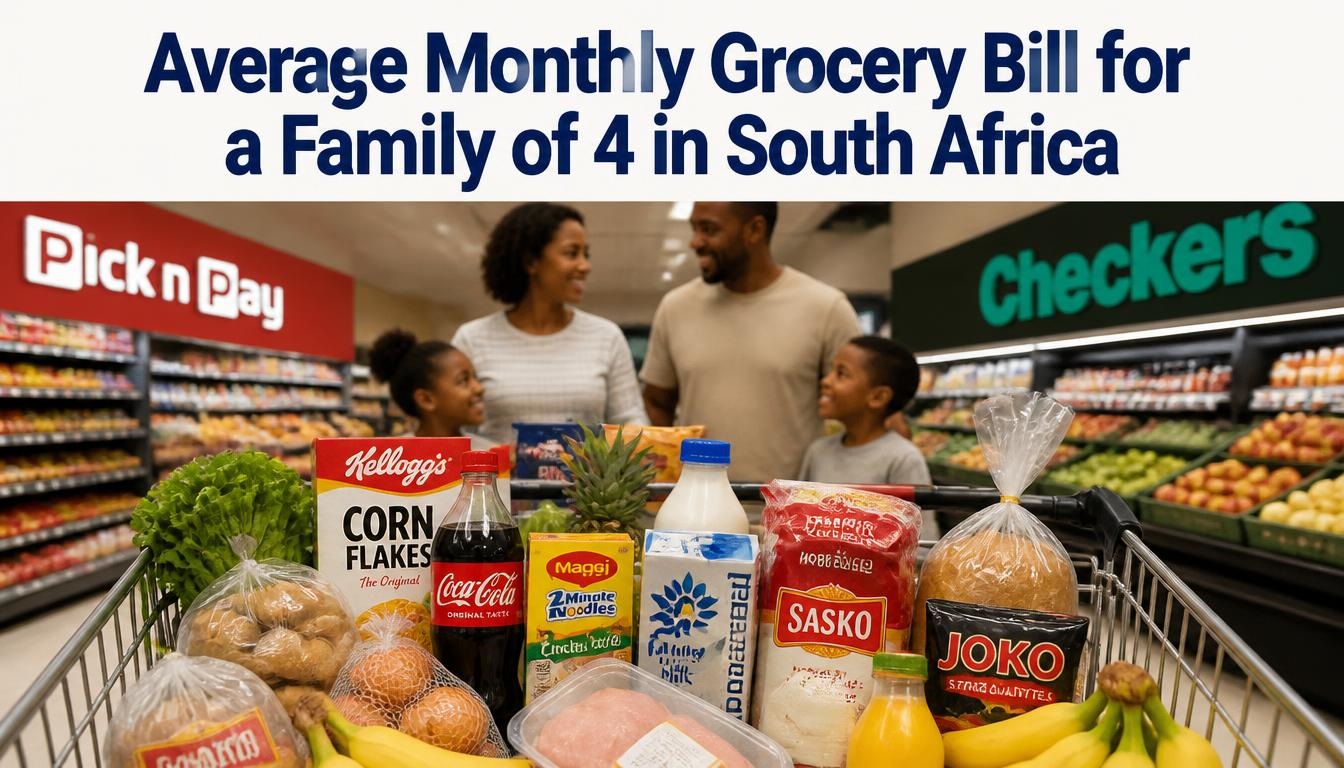
Shopping for groceries in South Africa has become a high-stakes balancing act between shrinking pack sizes, subtle store markups, and persistent food inflation. If you walk into a local supermarket without a strict budget, your monthly till slips will quickly spiral out of control. Calculating the average monthly grocery bill for a family of 4 in South Africa requires stripping away retail marketing noise and looking directly at independent market data, regional price splits, and store-by-store margins.
SA Family Food Budget Cheat Sheet (2026 Data)
What Does a Family Food Basket Actually Cost in South Africa?
Data tracked by the Pietermaritzburg Economic Justice & Dignity Group (PMBEJD) puts the national baseline for a core household basket around R5,479.80 to R5,502.42 per month. However, this figure covers bare-bones survival items for low-income households. A typical middle-class suburban family of four—balancing fresh meats, dairy, produce, personal care items, and packed lunches—spends between R6,500 and R8,500 per month at mainstream till points.
To see how these costs break down across different household lifestyle tiers, review the baseline spend profiles below:
| Household Budget Tier | Estimated Monthly Spend (ZAR) | Primary Retailers | Typical Basket Composition | Value Rating |
| Strict Budget / Wholesaler | R3,850 – R4,800 | Boxer, Shoprite, Jumbo Cash & Carry | Maize meal, rice, frozen chicken pieces, cabbage, potatoes, zero-rated staples | Excellent (Highest ROI) |
| Mid-Market Suburban | R5,400 – R7,800 | Checkers, Pick n Pay, Spar | Fresh beef, pork, dairy, branded pantry goods, basic household cleaning products | Good (Balanced Comfort) |
| Premium / Convenience | R9,500 – R14,000+ | Woolworths Food, SuperSpar, NetFlorist/Specialty | Free-range proteins, organic produce, imported deli items, ready-made meals | Low (Pay for Convenience) |
Breakdown of Everyday Household Staples
Understanding where your money goes at the checkout counter requires looking at unit costs for high-volume items. Supermarket pricing fluctuates weekly based on local agricultural yields, fuel price adjustments, and exchange rates.
The table below reflects average retail prices across major metropolitan hubs (Johannesburg, Cape Town, and Durban) for core grocery items:
| Grocery Item | Average Unit Size | Average Price Range (ZAR) | VAT Status | Budget Buying Tip |
| Maize Meal | 10 kg bag | R105.00 – R129.00 | Zero-Rated | Buy 10kg bulk bags at Shoprite Supermarkets – View Deals |
| Long Grain Parboiled Rice | 5 kg bag | R85.00 – R115.00 | Zero-Rated | Stick to house brands (Simple Truth, Ritebrand) |
| Sunflower Cooking Oil | 2 Litres | R69.00 – R89.00 | Standard 15% VAT | Watch for loss-leader promotions on 5L bottles |
| IQF Chicken Pieces | 4 kg bag | R175.00 – R210.00 | Standard 15% VAT | Check brine content percentages on the bag |
| Full Cream Fresh Milk | 2 Litres | R34.00 – R42.00 | Zero-Rated | UHT long-life milk bought by the carton saves 10% |
| White/Brown Bread | 700g Loaf | R17.50 – R22.00 | Brown is Zero-Rated | Brown bread avoids 15% VAT; white bread does not |
| Large Eggs | 30-Egg Tray | R85.00 – R110.00 | Zero-Rated | Buy 30-packs from regional farm stalls or hyperstores |
| Cheddar Cheese | 800g Block | R110.00 – R145.00 | Standard 15% VAT | Block cheese is 25% cheaper per kg than pre-sliced |
| Potatoes | 10 kg Pocket | R85.00 – R120.00 | Zero-Rated | Buy from municipal fresh produce markets where possible |
Why does a trolley with fewer items feel more expensive each month? Several structural factors inside the South African retail supply chain directly impact what you pay at the register.
The 15% VAT Split Trap
Under South African tax law, basic foodstuffs are zero-rated for Value Added Tax (VAT) to protect household purchasing power. Zero-rated items include brown bread, maize meal, rice, dried beans, fresh fruit, fresh vegetables, milk, eggs, and canned pilchards.
However, as soon as you add white bread, frozen IQF chicken, cooking oil, margarine, block cheese, sugary cereals, or personal hygiene products to your trolley, you incur a 15% VAT charge on those items. In an average suburban family trolley, up to 45% to 50% of the basket total attracts standard VAT, adding over R300 to R500 in indirect tax to your monthly bill.
-
Average Monthly Suburban Family Basket: R6,500
-
Zero-Rated Staples (50%): R3,250 (R0 VAT)
-
Standard Vatable Goods (50%): R3,250 (Includes ~R423.91 in 15% VAT)
Shrinkflation and Package Reductions
Major food manufacturers frequently lower unit weights while maintaining familiar price points to cover input costs. Common examples in South African aisles include:
-
Coffee tins dropping from 250g to 200g or 750g to 600g.
-
Cooking oil bottles moving from 2 Litres to 1.5 Litres or 750ml to 650ml.
-
Block cheeses shifting from 500g down to 400g.
-
Chocolate bars shrinking from 150g to 135g.
Always check the unit price (R/kg or R/L) printed on the shelf label rather than the front-of-pack display price.
Retailer Comparison: Where Should You Shop?
Choosing the right supermarket chain for your family’s shopping style can alter your monthly food bill by 15% to 30%.
Shoprite & Boxer
-
Best For: Tight budgets, bulk staple purchases, and zero-rated basics.
-
Strengths: Lowest baseline prices for maize, rice, flour, oil, and sugar. Excellent bulk deals on 10kg pockets of onions and potatoes.
-
Weaknesses: Smaller selections of premium fresh produce and specialized dietary products.
Checkers
-
Best For: Mid-to-high income families wanting high quality without paying Woolworths premiums.
-
Strengths: The Xtra Savings program provides immediate cash discounts at the till rather than slow points accumulation. Excellent meat selections (Simple Truth, Championship Boerewors) and competitive hyperstore pricing.
-
Weaknesses: Non-promotional shelf items can be marked up significantly higher than Shoprite equivalents.
Pick n Pay
-
Best For: Loyalty point collectors (Smart Shopper) and shoppers utilizing personalized discount vouchers.
-
Strengths: Broad product selection, solid bakery departments, and accessible store locations.
-
Weaknesses: Baseline pricing across middle-tier stores can be inconsistent unless items are bought on active Smart Shopper promotions.
Woolworths Food
-
Best For: High-income households prioritizing organic sourcing, cold-chain integrity, and convenience meals.
-
Strengths: Unmatched shelf life on fresh produce, strict quality controls, and clean ingredient profiles.
-
Weaknesses: Up to 25% to 40% more expensive overall compared to budget hypermarkets for equivalent basket volumes.
Strategic Tactics to Cut Your Family Grocery Spend
Implementing practical tactics can help bring down household food costs without compromising on nutritional needs.
-
Split Your Shopping Protocol: Purchase dry pantry goods, paper products, and bulk staples once a month at a hypermarket or cash-and-carry (e.g., Makro, Kit Kat Cash & Carry, or Jumbo). Buy fresh produce and dairy weekly at local farm stalls or competitive supermarkets.
-
Shop the Perimeter First: Supermarket layouts place high-margin processed foods, soft drinks, and snacks in central aisles. Stick to the outer perimeter (fresh produce, butchery, dairy) to keep your basket nutrient-dense and VAT-efficient.
-
Stack Store Loyalty Cards: Activate digital coupons on the Checkers Sixty60 / Xtra Savings app or PnP Smart Shopper app before entering the store. Personalize your discounts to target items you regularly buy.
-
Leverage Cash-Back Banking Perks: Link your supermarket trips to credit card rewards programs (e.g., FNB eBucks at Spar/Checkers, Discovery Bank Miles at Pick n Pay/Woolworths, or Absa Rewards). This can effectively rebate 5% to 15% of your monthly grocery spend back into your bank account.
Frequently Asked Questions
What is the Consumer Protection Act (CPA) rule on incorrect shelf pricing in South Africa?
Under Section 23 of the Consumer Protection Act (CPA), if a product is displayed with a lower shelf price than what scans at the till, the retailer is legally bound to sell you that item at the lowest displayed price. If multiple items are involved, you are entitled to buy the first item at the lower price, though retailers may correct the display error for subsequent units.
How much should I budget for non-food grocery items for a family of 4?
Hygiene products, cleaning detergents, trash bags, and toiletries typically add R800 to R1,400 per month on top of your food budget. Buying dishwashing liquids, washing powders, and toilet paper in bulk 18-packs or multi-liter refill tubs reduces these non-food operational costs significantly.
Are online grocery delivery services like Checkers Sixty60 or PnP Asap more expensive?
The product pricing on Sixty60 and PnP Asap mirrors in-store shelf prices, including active loyalty card discounts. However, factoring in the standard delivery fee (typically ~R35 per order) plus driver tips can add R200 to R350 per month if used weekly. The trade-off is that online shopping eliminates impulse buying and impulse aisle trips, which often saves more money overall.
Are you finding it tough to keep your family food budget under control this month? Share your recent till totals, store discoveries, or local bulk-buying spots in the comments below to help other South African shoppers navigate rising retail costs!
Disclaimer: Prices fluctuate regularly based on regional market conditions, retailer promotions, and inflation. Data reflects independent market analysis at the time of publication. We may earn a small affiliate commission through qualified links at no extra cost to you.

Joseph Mathebula is a consumer analyst and market researcher at Prices in South Africa. He specializes in tracking local service costs, retail pricing, and travel budgets, helping everyday shoppers navigate the market to secure the best value.