If you have ever been stranded in a shopping mall parking lot in Sandton or couldn’t start your car on a freezing winter morning in Johannesburg, you know that a dead battery gives no advance warning. Getting stuck without power is frustrating, costly, and inconvenient.
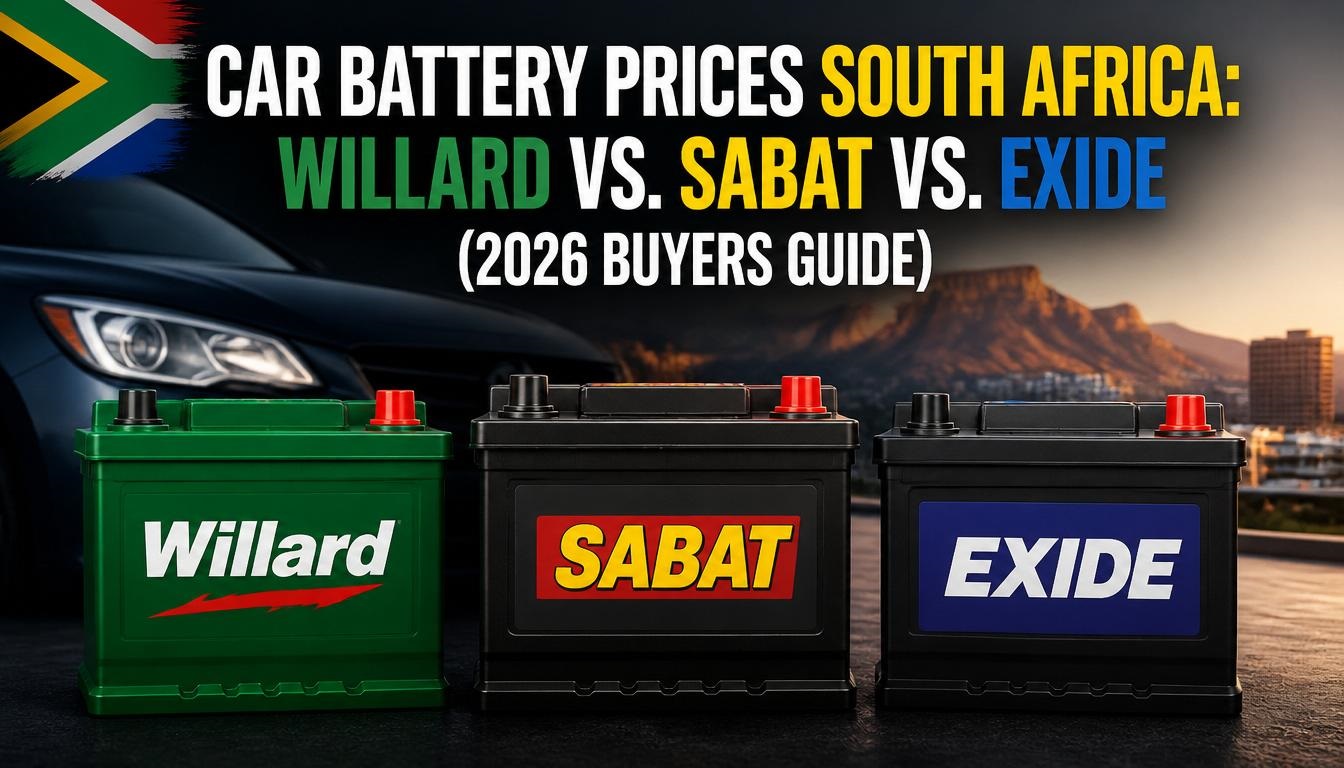
When buying a replacement car battery in South Africa, you will likely face three major brands: Willard, Sabat, and Exide. Choosing the right one can feel confusing when every auto spares shop claims their brand is best.
To help you make an informed decision, this guide breaks down real market prices, cold cranking amps (CCA), warranty terms, and real-world performance based on South African driving conditions.
Brand Overview: Who Builds What in South Africa?
Before looking at specific prices and specs, it helps to understand who actually manufactures these batteries and how they position themselves in the local market.
The South African battery market is primarily split between two major local manufacturers: AutoX (Pty) Ltd and First National Battery (FNB).
-
AutoX (Pty) Ltd: Produces both Willard and Sabat batteries at their manufacturing plant in Port Elizabeth / Gqeberha.
-
First National Battery: Manufactures Exide and heavy-duty commercial batteries out of their Benoni and East London facilities.
Willard Batteries (AutoX)
-
Market Position: Premium local flagship brand.
-
Manufacturing Origin: Port Elizabeth / Gqeberha, South Africa.
-
Key Strength: Built specifically for harsh South African heat cycles and high vibration on corrugated roads.
-
Best For: Drivers looking for maximum reliability, strong warranty support, and wide availability at stores like Supa Quick and AutoZone.
Sabat Batteries (AutoX)
-
Market Position: Performance-focused, budget-friendly alternative.
-
Manufacturing Origin: Port Elizabeth / Gqeberha, South Africa (produced in the same facility as Willard).
-
Key Strength: Offers slightly higher initial cranking punch for performance or tuned engines at a lower price point.
-
Best For: Value-conscious buyers who want local manufacturing quality without paying top-tier brand premiums.
Exide Batteries (First National Battery)
-
Market Position: Reliable everyday value workhorse.
-
Manufacturing Origin: Benoni / East London, South Africa.
-
Key Strength: Excellent amp-hour capacity ratings and strong performance in everyday commuting conditions.
-
Best For: Everyday commuters, fleet managers, and buyers looking for high quality at competitive pricing.
2026 Price Comparison & Specifications by Battery Size
Car batteries are categorized by standardized size numbers (like 618, 628, 646, or 652). To choose the right battery, check your car manual or look at the code printed on your current battery.
Below is a detailed price and performance breakdown across major battery codes in South Africa.
Note on Scrap Battery Credits: Prices listed below represent typical retail pricing. Trading in your old dead battery core at stores like AutoZone, Midas, or Battery Centre generally saves you between R150 and R300 off your purchase.
1. Small Hatchbacks & Sedans (618 / 619 Codes)
-
Common Vehicle Fits: Volkswagen Polo Vivo, Toyota Etios, Hyundai i10/i20, Ford Figo, Renault Kwid.
-
Electrical Requirements: Standard starting lighting, no complex start-stop systems.
2. Mid-Size Passenger Cars & Crossovers (628 / 629 Codes)
-
Common Vehicle Fits: Toyota Corolla Quest, Mazda 3, Nissan Almera, Volkswagen Golf, Kia Rio.
-
Electrical Requirements: Moderate power demands, tracking units, basic audio setups.
3. Compact SUVs & Executive Sedans (646 / 647 Codes)
-
Common Vehicle Fits: BMW 3-Series (E90), Mercedes-Benz C-Class, Audi A4, Renault Duster, Nissan Qashqai.
-
Electrical Requirements: Higher accessory load, multiple electronic control units (ECUs).
4. Large SUVs, Bakkies & Turbodiesels (652 / 658 Codes)
-
Common Vehicle Fits: Toyota Hilux, Ford Ranger, Isuzu D-Max, Toyota Fortuner, Volkswagen Amarok.
-
Electrical Requirements: High starter draw for diesel engines, winches, extra lights, heavy accessories.
Advanced Battery Technology: Standard Lead-Acid vs. EFB vs. AGM
If your car features modern Start-Stop technology (where the engine shuts off at traffic lights to save fuel), a standard lead-acid battery will fail prematurely. You must install either an EFB (Enhanced Flooded Battery) or an AGM (Absorbent Glass Mat) battery.
-
Standard Flooded (R1,200 – R2,200): Designed for basic starting needs with low electrical demand. Uses standard lead plates and liquid electrolyte.
-
Enhanced Flooded Battery / EFB (R2,500 – R3,500): Designed for entry-level start-stop systems. Offers double the cycle life of standard batteries thanks to reinforced internal plates.
-
Absorbent Glass Mat / AGM (R3,800 – R5,500): Designed for high-end luxury vehicles and modern turbodiesel SUVs. Uses glass mat separators saturated in acid to handle intense start-stop cycles and regenerative braking.
Why Battery Selection Matters for Start-Stop Cars
-
Standard Flooded: Designed only for starting the car once per journey and charging via the alternator. Installing this on a start-stop car can cause battery failure within 6 to 12 months.
-
EFB: Designed for basic start-stop systems without regenerative braking. Offers double the cyclic life of standard batteries.
-
AGM: Uses glass mat separators saturated in acid. Designed for high-end luxury vehicles and modern turbodiesel SUVs with heavy start-stop cycles and regenerative braking.
AGM Price Matrix (Willard vs. Sabat vs. Exide)
-
652 AGM Size: Willard (~R4,500 – R4,995) | Sabat (~R3,995 – R4,500) | Exide (~R3,800 – R4,300)
-
668 AGM Size: Willard (~R4,950 – R5,350) | Sabat (~R4,495 – R4,850) | Exide (~R4,200 – R4,700)
Crucial Installation Note: Replacing an AGM battery often requires registering the new battery to your car’s engine control unit (ECU) via a diagnostic scanner. Skipping this registration step can cause your alternator to overcharge and damage your new battery.
What Actually Kills Batteries in South Africa?
Understanding why batteries fail helps you extend their lifespan and save money.
1. Extreme Ambient Heat
While cold mornings reveal a weak battery, heat is what actually destroys it. Temperatures inside a vehicle engine bay in Gauteng, Limpopo, or the Karoo often exceed 60°C in summer. This heat accelerates internal grid corrosion and causes liquid electrolyte evaporation.
2. Short Trips & City Driving
If your daily commute is under 5 kilometers, your alternator does not have enough time to recharge the energy used to start the engine. Over time, the battery remains partially discharged, causing sulfation (hard lead sulfate crystals forming on the internal plates).
3. Parasitic Drain from Aftermarket Accessories
Modern vehicles in South Africa rely heavily on tracking units, dashcams, aftermarket alarms, and sound systems. If wired incorrectly, these devices slowly drain power while your car is parked, lowering the battery voltage below the safe threshold of 12.4V.
How to Check Your Battery at Home with a Multimeter
You don’t need to visit a fitment center to check your battery’s health. You can perform a quick test at home using an inexpensive digital multimeter.
Multimeter Testing & Voltage Readouts:
-
12.6V to 12.8V: Fully charged and healthy.
-
12.2V to 12.4V: Operating at roughly 50% capacity; needs a long drive or external charging.
-
Below 12.0V: Severely discharged or failing cell; needs replacement.
Steps to Test Your Battery:
-
Set your multimeter: Dial it to 20V DC.
-
Measure resting voltage: Place the red probe on the positive (+) terminal and the black probe on the negative (-) terminal while the car is turned off.
-
Measure cranking voltage: Have someone start the engine while watching the meter. If the voltage drops below 9.6V during startup, the battery has weak cold cranking power and is near the end of its life.
Practical Maintenance Checklist to Extend Battery Life
To get 3 to 5 years of service out of your car battery, follow this simple maintenance checklist:
-
Keep terminals clean: Inspect terminals regularly for white or blue powder (lead sulfate buildup). Clean them using warm water and baking soda, then apply petroleum jelly or silicone spray to prevent corrosion.
-
Ensure secure hold-downs: Check that the battery hold-down clamp is tight. Excessive vibration breaks internal plate welds and shortens battery life.
-
Limit short trips: If you drive mostly short distances, take a longer highway drive (20 to 30 minutes) once a week to let the alternator fully recharge the battery.
-
Disconnect power during long storage: If leaving your vehicle parked for over two weeks, disconnect the negative (-) terminal or attach a smart trickle charger.
Final Verdict: Which Battery Should You Buy?
-
Buy Willard if: You want peace of mind, a longer standard warranty (25 months), and hassle-free warranty returns across South Africa.
-
Buy Sabat if: You drive a performance vehicle, want strong cold-cranking performance, or want locally made quality at a lower price point.
-
Buy Exide if: You are working within a strict budget, managing a fleet, or simply want the best value for money per amp-hour.
Join the Discussion
What car do you drive, and how long has your current battery lasted in South African conditions? Have you had better long-term performance from Willard, Sabat, or Exide?
Drop your experience, questions, or current local battery prices in the comments section below!

Joseph Mathebula is a consumer analyst and market researcher at Prices in South Africa. He specializes in tracking local service costs, retail pricing, and travel budgets, helping everyday shoppers navigate the market to secure the best value.