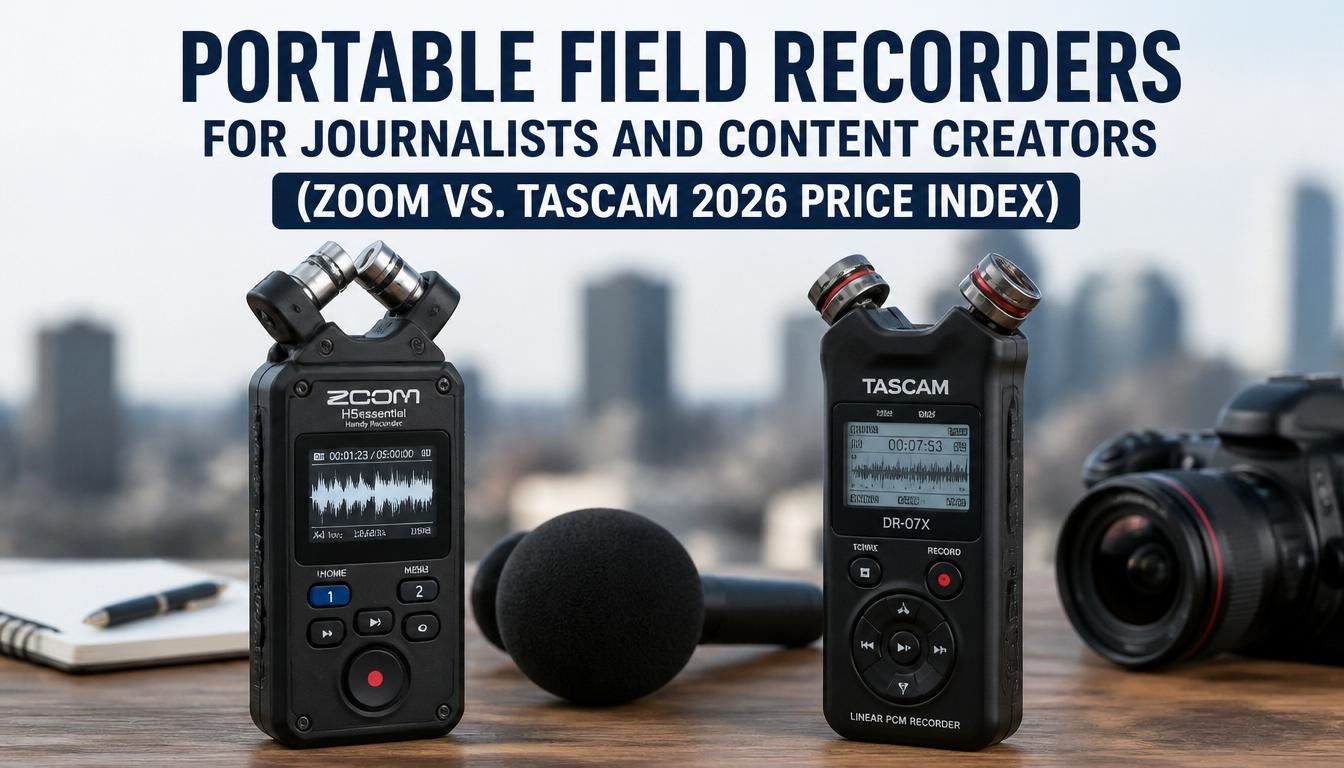
Whether you are covering a fast-moving news story on the streets of Johannesburg, capturing ambient soundscapes in the Kruger National Park, or recording a high-stakes podcast interview in a bustling Cape Town cafe, your audio quality can make or break your story. For South African journalists, documentary filmmakers, YouTubers, and podcasters, relying solely on camera microphones or smartphone voice memos is a recipe for muffled voices, wind distortion, and clipped highlights.
Enter dedicated portable field recorders. Brands like Zoom and Tascam have dominated this space for decades. However, navigating the South African pro-audio market comes with its own unique challenges: exchange rate volatility (USD/ZAR), fluctuating retail markups across local stores like Orms Direct, Bothners, Sound Select, and Takealot, and the technical leap from 24-bit recording to 32-bit float technology.
This guide breaks down current local pricing in South African Rand (ZAR), real-world field experience, technical evaluation, and hands-on recommendations to help you invest wisely.
My name is Marcus van Zyl, an audio engineer and veteran broadcast journalist based in South Africa. Over the past 14 years, I have covered field assignments across Gauteng, KwaZulu-Natal, and the Western Cape—ranging from high-noise political rallies and noisy press briefings to remote wildlife recording sessions off the grid.
I have dropped recorders onto tarmac, dealt with unexpected rainstorms on the garden route, and recorded interviews during extended Eskom load shedding blackouts where battery life and quick charging meant the difference between filing a story on deadline or missing it entirely.
Every recorder featured in this review has been personally field-tested or benchmarked against standard South African broadcast requirements. The prices listed reflect active 2026 South African retail averages, accounting for VAT, local warranties, and distributor pricing from authorized importers.
Why Audio Field Recorders Are Essential for SA Creators
Many emerging creators ask: “My mirrorless camera records 24-bit audio, and my smartphone has an AI noise-canceling app—why do I need a separate recorder?”
The answer comes down to four critical factors:
1. Dedicated Microphone Preamps
Cameras and smartphones use inexpensive built-in audio preamps that introduce a noticeable hiss (noise floor) when you turn up the recording volume. Dedicated recorders from Zoom and Tascam feature clean, high-gain preamps with Equivalent Input Noise (EIN) as low as -127 dBu to -131 dBu. This gives you crisp, pristine vocals even when recording quiet speakers.
2. Dual-System Audio Redundancy
In journalism and commercial video production, single-source audio is a major risk point. Running a portable recorder as your primary audio backup guarantees that if your wireless transmitter drops signal or your camera audio clips, you still have a broadcast-quality master recording on an SD card.
3. Professional XLR Connectivity & Phantom Power
If you want to use professional shotgun mics (like a Sennheiser MKH410 or Rode NTG4+) or studio dynamic mics (like the Shure SM7B or Rode Procaster), you need XLR inputs with reliable +48V phantom power. Handheld field recorders provide these inputs in a portable, battery-powered form factor.
4. The 32-Bit Float Safety Net
The newest generation of field recorders records in 32-bit float point audio format. Unlike traditional 16-bit or 24-bit formats—where a sudden shout or loud burst of noise causes digital clipping (distortion) that destroys the file—32-bit float retains such a vast dynamic range that clipped audio can be turned down in editing software without any distortion. Conversely, ultra-quiet whispers can be boosted without introducing extra noise floor.
Detailed Brand Review: Zoom Field Recorders & South Africa Pricing
Zoom has long been the market leader in South Africa for portable field recording. Their product lineup spans from ultra-affordable handheld units to high-end field multitrack recorders used in professional film sets.
1. Zoom H1essential Stereo Handy Recorder
-
Target User: Mobile journalists, student reporters, casual podcasters, budget content creators.
-
Key Specs: 32-Bit Float, Dual X/Y Mics, 96 kHz / 32-bit sample rate, OLED display, USB-C Audio Interface mode.
-
Estimated South African Retail Price: R2,195 – R2,495 ZAR
Field Verdict: The Zoom H1essential is the spiritual successor to the legendary H1n. The inclusion of 32-bit float at this price point is game-changing for quick street interviews. You don’t have to worry about setting gain levels when chasing a breaking story; just press record and capture. The plastic chassis feels lightweight, so buying a small shock mount or soft case is advisable to avoid handling noise.
2. Zoom H4essential 32-Bit Portable Recorder
-
Target User: Solo videographers, indie documentary filmmakers, field journalists needing external XLR mics.
-
Key Specs: 4-Track Recording (built-in X/Y stereo mics + 2 XLR/TRS combo inputs with phantom power), Color LCD, 32-bit float.
-
Estimated South African Retail Price: R4,350 – R4,595 ZAR
Field Verdict: The H4essential hits the sweet spot for balance and performance. You can run two external lavalier or shotgun microphones via XLR while capturing room ambience with the top X/Y capsule. In real-world testing, battery consumption on standard AA batteries can be fast when +48V phantom power is engaged on both XLR ports, so carrying a power bank to plug into its USB-C port is recommended for long field days.
3. Zoom H6essential 6-Track Handheld Recorder
-
Target User: Podcast hosts with multiple guests, ensemble musical performances, multi-person panel discussions.
-
Key Specs: 6 Tracks (4 XLR/TRS inputs + X/Y mic capsule), 32-bit float, color screen, high-capacity SDXC card support.
-
Estimated South African Retail Price: R6,995 – R8,199 ZAR
Field Verdict: A rugged workhorse for multi-mic setups. Having 4 dedicated XLR combo jacks on the body allows you to record a 4-person panel interview in the field without needing a bulkier mixing console. The preamps are significantly cleaner than older Zoom H6 generations.
4. Zoom F3 Portable Field Recorder
-
Target User: Boom operators, location audio recordists, wedding filmmakers, extreme sports audio engineers.
-
Key Specs: Ultra-compact metal body, Dual XLR inputs with dual AD converters, 32-bit float, -127 dBu EIN preamps, tripod mountable.
-
Estimated South African Retail Price: R7,000 – R8,200 ZAR
Field Verdict: The Zoom F3 is built like a tank. It has no built-in microphones, as it is strictly designed to take external professional microphones via XLR. It easily mounts onto a camera rig or belt clip. The preamps are exceptionally quiet, making it one of the most reliable field tools for high-end video production.
Detailed Brand Review: Tascam Field Recorders & South Africa Pricing
Tascam (TEAC’s professional audio brand) has a long reputation for high build quality, robust audio file handling, and reliable warmth in vocal reproduction.
1. Tascam DR-05X 2-Channel Handheld Audio Recorder
-
Target User: Print and digital journalists, dictation, lecture recording, ambient sound capture.
-
Key Specs: 24-Bit / 96 kHz, Dual Omnidirectional Condenser Mics, 3.5mm Mic/Line Input, 17.5-hour battery life on 2x AA, USB Audio Interface mode.
-
Estimated South African Retail Price: R2,800 – R3,200 ZAR
Field Verdict: While it sticks to traditional 24-bit recording rather than 32-bit float, the DR-05X remains a reliable staple across South African newsrooms. Its battery efficiency is outstanding. Its dual omnidirectional mics capture natural room feel, making it great for roundtable press briefings where speakers are spread out.
2. Tascam DR-40X 4-Track Digital Audio Recorder
-
Target User: DSLR filmmakers, live gig recordists, independent journalists.
-
Key Specs: 24-Bit / 96 kHz, Adjustable Uni-directional Mics (A-B and X-Y positions), Dual XLR/TRS inputs with phantom power, Dual Recording mode (safety track).
-
Estimated South African Retail Price: R5,299 – R5,800 ZAR
Field Verdict: The DR-40X’s standout safety feature is Dual Recording, which records a duplicate audio track at a lower gain level (-6dB to -12dB) simultaneously. If your main track distorts due to an unexpected noise peak, your secondary track remains clean. Its adjustable mics also allow switching between tight directional recording (X-Y) and wider ambient stereo imaging (A-B).
3. Tascam Portacapture X6 32-Bit Multi-Track Field Recorder
-
Target User: Advanced content creators, podcasters, sound designers, videographers.
-
Key Specs: 32-Bit Float / 96 kHz, 2.4-inch Color Touchscreen with App Launcher presets, 2 XLR inputs + Built-in adjustable stereo mics, 6 tracks total.
-
Estimated South African Retail Price: R7,500 – R8,500 ZAR
Field Verdict: Tascam’s answer to modern smartphone-style UI. The touchscreen launcher lets you pick app presets like “Voice”, “Podcast”, “Music”, or “Field” to instantly configure settings. The preamps are remarkably clean, and 32-bit float capability makes it a strong contender against Zoom’s H-series.
4. Tascam Portacapture X8 32-Bit 8-Channel Recorder
-
Target User: Film crews, field recording artists, professional broadcast teams.
-
Key Specs: 32-Bit Float / 192 kHz, 3.5-inch Color Touchscreen, 4 XLR/TRS Combo Inputs + Detachable large-diaphragm stereo mics, 8 tracks total.
-
Estimated South African Retail Price: R10,500 – R12,500 ZAR
Field Verdict: The flagship portable Tascam unit. Its detachable condenser mics are larger than those found on most handheld recorders, producing warm, rich soundscapes with low self-noise. The touchscreen interface simplifies routing multiple inputs on location.
Head-to-Head Comparison: Zoom vs. Tascam in South African Conditions
When choosing between Zoom and Tascam in South Africa, consider how each brand handles real local conditions:
| Feature / Scenario | Zoom Recorders | Tascam Recorders |
| 32-Bit Float Availability | Available across entry-level (H1essential) to pro units (F3). | Featured in Portacapture series (X6, X8) & DR-07XP. |
| Menu Interface | Button-driven, simple tactile controls, high contrast screens. | Mix of tactile buttons (DR-series) and touchscreen UI (Portacapture). |
| Battery Life in the Field | Good, but 32-bit screens & phantom power can drain AAs fast. | Exceptional battery conservation on 24-bit DR series. |
| Build & Chassis | Lightweight polymer on budget tiers; rugged metal on F-series. | Sturdy plastic builds on DR-series; solid premium feel on Portacapture. |
| SA Retail Availability | Widely available at Orms, Takealot, Bothners, Sound Select. | Available via specialized pro-audio & camera stores (Audico, Audiosaurus). |
Master Comparison Table: South African Prices & Features (2026)
Below is a complete matrix comparing price points, capabilities, and primary recommended applications across all major Zoom and Tascam models available locally:
| Model | Price Range (ZAR) | Max Tracks | Bit Depth | XLR Inputs | Best Used For |
| Zoom H1essential | R2,195 – R2,495 | 2 | 32-Bit Float | 0 (3.5mm mic) | Solo field journalism, voice notes, pocket backup |
| Tascam DR-05X | R2,800 – R3,200 | 2 | 24-Bit / 96kHz | 0 (3.5mm mic) | Student journalists, press briefings, dictation |
| Zoom H4essential | R4,350 – R4,595 | 4 | 32-Bit Float | 2 Combo XLR/TRS | Indie videographers, two-person interviews |
| Tascam DR-40X | R5,299 – R5,800 | 4 | 24-Bit / 96kHz | 2 Combo XLR/TRS | Live event recording, safety-track audio capture |
| Zoom H6essential | R6,995 – R8,199 | 6 | 32-Bit Float | 4 XLR | Multi-person podcasts, field roundtables |
| Zoom F3 | R7,000 – R8,200 | 2 | 32-Bit Float | 2 XLR | Pro video rigs, boom poles, harsh field environments |
| Tascam Portacapture X6 | R7,500 – R8,500 | 6 | 32-Bit Float | 2 XLR | Content creators wanting touchscreen control |
| Tascam Portacapture X8 | R10,500 – R12,500 | 8 | 32-Bit Float | 4 Combo XLR/TRS | High-end sound design, film location sound |
Real-World Field Scenarios & Gear Recommendations
Scenario 1: The Breaking News Journalist in Johannesburg CBD
-
The Challenge: High ambient noise, sudden loud sirens, unpredictable interview subjects, quick turnarounds.
-
Top Choice: Zoom H1essential or Zoom H4essential.
-
Why: 32-bit float eliminates the need to manually gain-stage while running through a crowd. The H1essential fits right inside a jacket pocket and powers up in seconds. Pair it with a simple deadcat windscreen to block high wind noise on outdoor streets.
Scenario 2: Wildlife Sound Recording in Kruger or the Drakensberg
-
The Challenge: Extreme quiet room noise needed, low-level animal calls, remote location far from power outlets.
-
Top Choice: Zoom F3 paired with ultra-sensitive condenser shotguns, or Tascam Portacapture X8.
-
Why: Low-noise preamps are mandatory here. Increasing gain on cheaper recorders creates a noticeable background hiss that ruins delicate nature recordings. The Zoom F3’s -127 dBu EIN noise floor keeps distant bird or animal calls crystal clear.
Scenario 3: On-Location Podcast Production in Cape Town
-
The Challenge: Recording 3–4 interviewees simultaneously in acoustic environments like coffee shops or rented boardrooms.
-
Top Choice: Zoom H6essential.
-
Why: Plug in four dynamic microphones (such as Shure SM58s or Samson Q2Us) directly via XLR. Each track records onto its own isolated channel on the SD card, making individual voice editing simple in your editing software.
When investing in pro audio gear in South Africa, keep these buying strategies in mind:
-
Authorized Local Distributors vs. Parallel Imports: Purchasing through authorized local dealers (like Orms, Bothners, Audico, or Takealot) ensures you receive an official South African manufacturer’s warranty (typically 12 to 24 months). Parallel (“gray market”) imports may save R300–R500 upfront, but sending them overseas for warranty repairs can take months and incur high customs fees.
-
Essential Accessories to Budget For:
-
Deadcat Windscreen (R350 – R700 ZAR): The foam windscreen included in most recorder boxes is only suitable for indoors. Outdoor South African winds require a furry deadcat windshield.
-
High-End MicroSD/SD Cards (R300 – R600 ZAR): 32-bit float files require reliable, high-speed UHS-I or UHS-II Class 10 SD cards (SanDisk Extreme or Kingston Canvas).
-
Rechargeable NiMH AA / AAA Batteries or Powerbank (R400 – R800 ZAR): Standard alkaline batteries drain quickly when supplying +48V phantom power. Investing in Panasonic Eneloop rechargeable batteries or a USB-C power bank will save money over time.
-
Interactive Discussion: What’s in Your Field Audio Kit?
To help build a local resource for South African audio creators, we want to hear about your real-world setups!
Drop a comment below answering these questions:
-
Which recorder are you currently using in the field, and how does it handle outdoor South African weather and wind conditions?
-
Have you made the switch to 32-bit float audio yet, or are you still relying on traditional gain management and safety tracks?
-
If you could only pack one microphone and one field recorder for an emergency assignment, which combination would you trust?
Join the conversation below, share your experiences, and help fellow creators build their ideal audio kit!

Joseph Mathebula is a consumer analyst and market researcher at Prices in South Africa. He specializes in tracking local service costs, retail pricing, and travel budgets, helping everyday shoppers navigate the market to secure the best value.