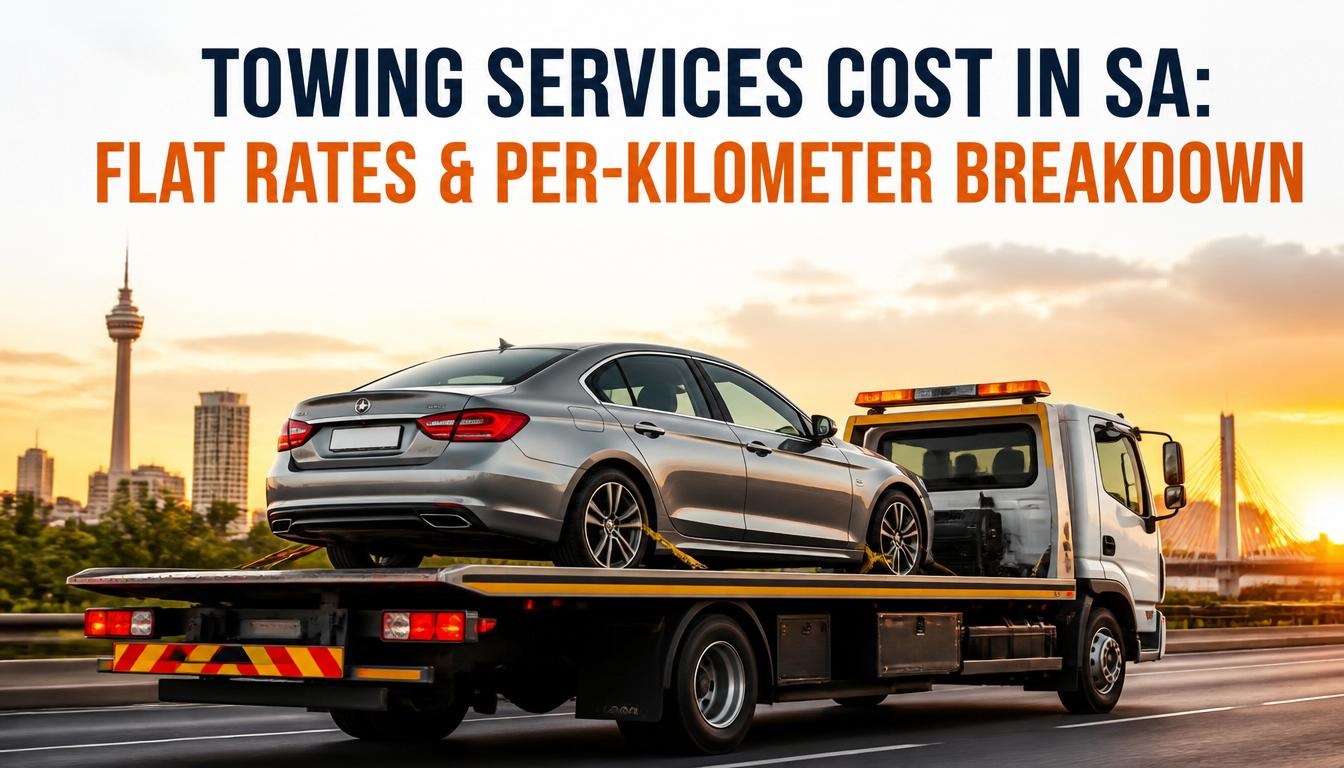
Having spent over fifteen years navigating South Africa’s automotive landscape—from managing fleet logistics across the N3 corridor to helping stranded motorists on the N1 off-ramps in Johannesburg—I have seen firsthand how vulnerable drivers become when their car breaks down or ends up in a collision.
Picture this: It is 8:45 PM on a rainy Sunday evening along the M1 highway near Woodmead. Your engine temperature gauge spikes into the red, white steam pours out from under the bonnet, and your car loses all power. Within seven minutes, before you even have a chance to call your insurance broker, an unmarked tow truck with flashing amber lights pulls up behind you. The driver jumps out, smiles warmly, hands you a clip-board, and says, “Don’t worry, my friend, we’ll just drop your car at our yard nearby and let your insurance handle it tomorrow.”
If you sign that form without understanding how towing pricing works in South Africa, you could wake up the next morning to a bill exceeding R8,500 for a 12-kilometer haul.
Unlike municipal public transport or regulated taxi fares, towing services in South Africa operate in a largely unregulated free-market environment. Unless you are using an insurance-approved contractor or a verified association member, tow operators can charge whatever the market—or a desperate driver—will bear.
In this comprehensive guide, we unpack exact flat rates, per-kilometer tariffs, hidden administration fees, storage costs, and the legal rights every South African motorist must know before calling for roadside assistance.
1. Breakdown Towing vs. Accident Recovery Towing: The Great Price Divide
The first critical fact every South African driver must understand is that towing industry pricing is split into two entirely different categories: Mechanical Breakdown Towing and Accident Recovery Towing.
Mechanical Breakdown Towing
This applies when your vehicle suffers a non-collision failure—such as a blown head gasket, dead alternator, flat battery on a freeway shoulder, or snapped timing belt. Because there is no road debris cleanup, no specialized winching required, and no high-risk insurance liability involved, breakdown towing is priced at predictable commercial rates.
-
Billing Structure: Base call-out fee + per-kilometer charge (or a fixed local flat rate).
-
Average Cost: R650 to R1,850 for local urban distances under 20 km.
Accident Recovery Towing
This applies when your vehicle is involved in a collision, rollover, or off-road impact. Because the vehicle may have locked wheels, deployed airbags, leaking fluids, or frame damage, the job requires specialized equipment, additional labor, scene safety management, and hazard containment.
-
Billing Structure: Flat recovery package + winch fee + fluid cleanup fee + daily storage charges + per-kilometer transport fees.
-
Average Cost: R2,500 to R9,500+ depending on the complexity of the recovery.
Expert Warning: If you break down on a busy South African highway, rogue operators will sometimes try to classify a simple mechanical breakdown as a “hazard recovery” just to charge accident rates. Never allow an operator to write “Accident Tow” on your work order if your car simply ran out of fuel or overheated.
2. Average Towing Rates in South Africa
The table below outlines current realistic market tariffs charged across South Africa by independent towing operators and accredited members of the South African Towing and Recovery Association (SATRA) and the United Towing Association of South Africa (UTASA).
Overview of Towing Service Fees in South Africa
| Service Type | Average Base / Call-Out Fee | Per-Kilometer Rate (After Included Radius) | Included Radius | Total Estimated Cost (Local 15 km) |
| Standard Light Vehicle Breakdown (Sedan / Hatchback) | R550 – R850 | R18 – R28 / km | 5 km – 10 km | R750 – R1,350 |
| SUV, Bakkie & 4×4 Breakdown | R700 – R1,100 | R22 – R32 / km | 5 km – 10 km | R950 – R1,650 |
| Luxury / Low-Clearance Vehicle (Rollback Flatbed) | R850 – R1,400 | R25 – R38 / km | 0 km – 5 km | R1,200 – R2,200 |
| Motorcycle Towing (Cradle / Strapped Rollback) | R450 – R700 | R15 – R22 / km | 5 km | R600 – R1,000 |
| Accident Scene Recovery (Light Vehicle) | R2,200 – R4,800 (Flat Rate) | R30 – R45 / km (Beyond 20 km) | 15 km – 20 km | R2,500 – R5,500 |
| Heavy Commercial / Truck Recovery (8 Ton+) | R3,500 – R8,500 Base | R45 – R85 / km | 0 km | R5,000 – R15,000+ |
3. Detailed Per-Kilometer & Flat Rate Pricing Models Explained
To avoid getting caught out by confusing quotes, it helps to understand how towing companies calculate your total invoice. Most independent towers use one of three main pricing models:
Model A: Pure Flat Rate (Urban Local Towing)
For short-distance transports within major city boundaries (e.g., Sandton to Midrand, Bellville to Cape Town CBD, or Umhlanga to Durban Central), many operators offer an all-inclusive flat rate.
-
What it covers: Call-out, loading, up to 15 or 20 kilometers of travel, and offloading at a workshop or home address.
-
Typical Cost: R750 to R1,200 for standard passenger cars.
-
When it applies: Pre-booked mechanical moves, trade tows, or non-emergency local breakdowns during standard working hours (8:00 AM to 5:00 PM Monday to Friday).
Model B: Base Fee + Per-Kilometer Charge
This is the standard model used for suburban, night-time, or long-distance towing.
-
Formula: Total Cost = Base Call-Out Fee + [(Total Distance Traveled – Included Allowance) × Per-Km Rate] + Surcharges.
-
Example Calculation:
Suppose you break down on the N2 between Somerset West and Grabouw, requiring a 45 km tow back to Cape Town.
-
Base Call-Out Fee (includes first 10 km): R750
-
Remaining Distance: 35 km
-
Per-Kilometer Rate: R24 / km (35 km × R24 = R840)
-
After-Hours Surcharge (10:00 PM): R300
-
Total Estimated Bill: R1,890
-
Model C: Long-Distance Cross-Province Towing
If you suffer a vehicle breakdown in remote regions—such as the Karoo along the N1, the N3 through van Reenen’s Pass, or the N4 near Nelspruit—local towers must travel significant distances to reach you and transport your vehicle to a primary service hub.
-
Long-Distance Rate: R18 to R32 per kilometer calculated round-trip (from the towing depot to your location, to your destination, and back to the depot).
-
Example: A 250 km tow from Beaufort West to George can easily cost between R6,500 and R10,500.
4. Regional Price Comparisons Across South Africa
Towing prices are directly influenced by local fuel prices, highway traffic density, toll costs, and regional labor rates. Here is how charges vary across South Africa’s major economic hubs:
Regional Cost Variations for Standard Light-Vehicle Towing (15 km Distance)
| Region / Major Corridor | Standard Breakdown Tow | Accident Base Tow | Average Storage Fee / Day | Key Regional Factor |
| Gauteng (JHB & PTA) | R700 – R1,100 | R2,500 – R5,000 | R250 – R450 | High competition; heavy traffic delays; freeway toll fees. |
| Western Cape (Greater Cape Town) | R800 – R1,300 | R2,800 – R5,500 | R300 – R500 | Longer travel distances between metro hubs; high weekend demand. |
| KwaZulu-Natal (Durban / PMB Corridor) | R650 – R1,050 | R2,200 – R4,500 | R200 – R400 | Steep terrain on N3/M13 routes requires heavy winch gear. |
| Eastern Cape (Gqeberha / East London) | R600 – R950 | R2,000 – R4,000 | R180 – R350 | Fewer independent operators; longer response times in rural areas. |
| National Highways (N1, N3, N4 Rural Corridors) | R1,200 – R2,800 | R3,500 – R7,500 | R250 – R450 | Round-trip kilometer billing; long dispatch distances. |
When motorists receive an unexpectedly high towing bill, it is rarely the per-kilometer rate that causes the price jump. Instead, it is the accumulation of secondary surcharges itemized on the final invoice.
Here are the most common extra costs in South Africa:
| Fee Item | Average Cost Range | Why It Is Charged |
| After-Hours / Night Surcharge | R250 – R600 | Applied between 6:00 PM and 6:00 AM, as well as on Sundays and Public Holidays. |
| Winching & Recovery Fee | R800 – R2,500 | Charged if your car is stuck in a ditch, embankment, mud, or has locked wheels. |
| Daily Storage Fee | R150 – R500 / day | Charged every calendar day (including weekends) your vehicle sits in the tower’s yard. |
| Administration / Gate Release Fee | R350 – R850 | A mandatory charge levied by private storage yards to release your car to your insurer. |
| Dollies / Special Transport Wheels | R450 – R900 | Required for all-wheel-drive (AWD) or automatic vehicles with locked transmissions. |
| Oil Cleanup & Debris Removal | R350 – R750 | Charged on accident scenes for clearing shattered glass, radiator fluid, or engine oil. |
Real Experience from the Field: In 2023, a motorist in Johannesburg was involved in a minor fender bender. The vehicle was towed just 8 kilometers to a private holding yard. Due to a weekend delay in insurance processing, the car sat in storage for three days. The breakdown of the final R6,200 bill was:
Base Accident Tow: R2,800
After-Hours Surcharge: R450
Cleanup Fee: R450
3 Days Storage @ R400/day: R1,200
Gate Release & Admin Fee: R650
VAT (15%): R650
Knowing these line items upfront allows you to challenge inflated charges before signing any release documents!
6. Flatbed vs. Sling-Back Towing: Cost and Risk Comparison
Not all tow trucks are created equal. In South Africa, you will primarily see two types of tow vehicles operating on the road: Rollback Flatbeds and Wheel-Lift / Sling-Back Trucks.
1. Rollback Flatbed Trucks
The entire flatbed hydraulic bed tilts down to form a ramp, allowing the vehicle to be winched or driven directly onto the truck bed.
-
Best For: Modern automatic transmission cars, All-Wheel Drive (AWD/4WD) SUVs, sports cars with low ground clearance, and heavily damaged vehicles.
-
Pricing: 15% to 30% higher base fee than sling towing due to equipment costs.
-
Risk Factor: Low. Prevents mechanical strain on driveline components, tires, and suspension.
2. Sling-Back / Wheel-Lift Trucks
Lifts either the front or rear wheels off the ground, leaving the remaining two wheels rolling on the pavement.
-
Best For: Short-distance urban moves for manual transmission front-wheel-drive light cars, or tight basement parking recoveries where flatbeds cannot fit.
-
Pricing: Cheaper base fee (R550 – R850 local).
-
Risk Factor: High for automatic or 4WD vehicles! Towing an automatic vehicle with its drive wheels on the ground can completely destroy its transmission within a few kilometers.
7. Your Legal Rights as a South African Motorist
The Automobile Association of South Africa (AA) frequently highlights that drivers feel intimidated on accident scenes. Understanding your constitutional and consumer rights is your best line of defense:
The 5 Golden Rules of Towing Rights in SA
-
You Have Final Authority Over Your Vehicle: Unless you are physically incapacitated, police officers or tow operators cannot force you to use a specific tow truck company unless your vehicle is actively blocking traffic and poses an immediate danger.
-
The First Tow Rule: If you have comprehensive motor insurance, your insurer almost certainly covers your towing costs—BUT ONLY if you call their dedicated emergency assistance line first. If you allow an unapproved operator to tow your car, your insurer may refuse to pay the bill, leaving you personally liable for thousands of Rands!
-
Never Sign a Blank Towing Slip: Rogue operators often present a form with blank pricing fields, promising to “fill in the details with your insurance later.” Signing a blank form gives them legal permission to insert exorbitant rates, daily storage fees, and admin surcharges.
-
Cross Out Unwanted Destination Yards: Ensure the destination address written on the towing form is either an insurance-approved panel beater, your vehicle’s dealership, or your home address—never an unknown private storage yard unless explicitly approved by your broker.
-
Clear Out Personal Valuables Immediately: Remove all personal possessions—laptops, sunglasses, spare change, tools, and registration papers—before the vehicle is hooked up. Towing companies carry limited liability for loose items inside stored vehicles.
8. How to Avoid “Towing Vultures” on South African Roads
In industry slang, “towing vultures” are unaccredited operators who monitor police scanners and highway traffic cameras to arrive unannounced at accident scenes. While there are many honest, professional independent operators in SA, rogue towers exploit stranded motorists.
Checklist: How to Verify an Operator on the Scene
Before permitting anyone to touch your car, run through this quick 4-step checklist:
-
Step 1: Check for Industry Accreditation
Look for official decals on the tow truck doors indicating membership in SATRA (South African Towing and Recovery Association) or UTASA (United Towing Association of South Africa). Members adhere to a strict code of conduct and standardized billing practices.
-
Step 2: Demand a Written Quote on the Spot
Ask the driver: “What is your base call-out fee, what is your per-kilometer rate after 10 km, and do you charge daily storage fees?” If they hesitate or refuse to give explicit numbers, do not let them touch your car.
-
Step 3: Call Your Insurance Roadside Line First
Even if the tow truck driver claims, “I work with all major insurers,” phone your insurer directly to confirm their vehicle registration number.
-
Step 4: Take Photos of the Vehicle Before Loading
Snap clear, time-stamped pictures of your car’s exterior from all angles before it is loaded onto the tow bed. This provides undeniable proof if new scratches, bumper tears, or interior damage occur during transport.
9. Comprehensive Comparison: Independent Pay-as-You-Go vs. Roadside Assistance Subscriptions
Is it cheaper to pay out-of-pocket when you break down, or should you maintain an annual roadside assistance membership? Let’s compare the numbers over a 3-year period:
Cost Comparison Over 3 Years
| Factor / Scenario | Independent Out-of-Pocket Tow | AA Membership / Bank Value-Add Cover | Comprehensive Auto Insurance Included Cover |
| Upfront Annual Fee | R0 | R1,100 – R2,200 / year | Included in monthly premium |
| Cost for 1 Local Breakdown (15 km) | R750 – R1,350 | R0 (Covered up to policy limit) | R0 (Covered via emergency protocol) |
| Cost for 1 Long-Distance Breakdown (100 km) | R2,500 – R4,200 | Covered up to standard distance limit (e.g., 50-100 km) | Covered to nearest approved facility |
| Additional Services (Fuel, Jumpstarts, Keys) | Paid individually (R400 – R800 per service) | Free (limited uses per year) | Free via dispatch line |
| Total 3-Year Estimated Outlay (Assuming 2 Tows) | R1,800 – R3,500 | R3,300 – R6,600 | R0 extra beyond standard premium |
The Takeaway: If your vehicle is covered under comprehensive motor insurance or a manufacturer warranty, you already pay for towing assistance! Make sure you store your insurer’s emergency contact number on your phone today. If you drive an older vehicle without comprehensive insurance, subscribing to a roadside assistance provider like the AA or adding towing cover to your bank account package (e.g., Capitec, FNB, or Standard Bank value-adds) can easily save you thousands in an emergency.
Have You Been Caught Out by Unexpected Towing Costs in SA?
We want to hear from you! Have you ever had a smooth towing experience on South African highways, or were you hit with unexpected storage fees and per-kilometer surcharges?
-
What was the highest per-kilometer rate or hidden charge you’ve seen on an invoice?
-
Did your insurance company reimburse your full towing claim without hassle?
Drop your experiences, questions, and city locations in the comments section below—your story could help save a fellow South African motorist from making an expensive mistake on the road!

Joseph Mathebula is a consumer analyst and market researcher at Prices in South Africa. He specializes in tracking local service costs, retail pricing, and travel budgets, helping everyday shoppers navigate the market to secure the best value.